

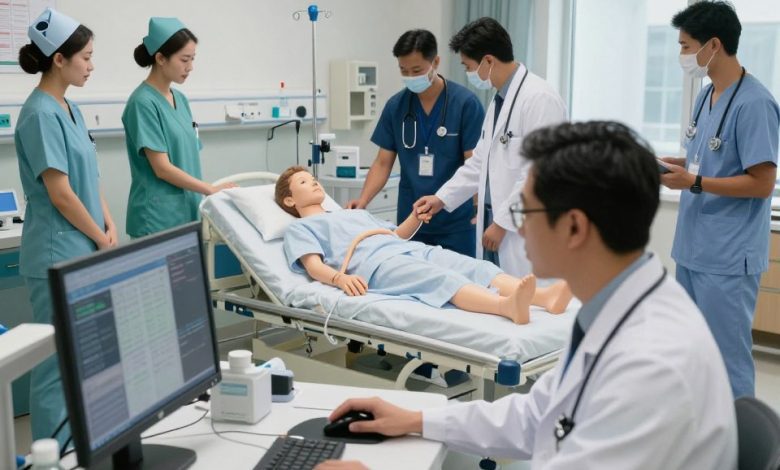
Healthcare training is undergoing a significant transformation with the advent of simulation-based education. One pioneering approach is Oxford Medical Simulation, which is revolutionizing the way healthcare professionals learn and practice critical skills.
By leveraging advanced simulation technology, healthcare providers can now engage in realistic and immersive training experiences that enhance their clinical skills and decision-making abilities. This innovative approach to medical education has the potential to significantly improve patient outcomes and reduce errors.
Key Takeaways
- Oxford Medical Simulation is transforming healthcare training through simulation-based education.
- Simulation technology enhances clinical skills and decision-making abilities.
- Advanced training experiences improve patient outcomes and reduce errors.
- Healthcare professionals can practice critical skills in a realistic and immersive environment.
- Simulation-based education is revolutionizing medical education.
The Power of Oxford Medical Simulation
Oxford Medical Simulation is revolutionizing healthcare training with its cutting-edge technology. This innovative approach to medical education is making it possible for healthcare professionals to train in a highly realistic and immersive environment.


Read more:- US Citizens: Qualify for a $2000 Direct Deposit
What Is Virtual Reality Simulation in Healthcare?
Virtual reality simulation in healthcare involves the use of advanced computer technology to create realistic clinical scenarios. This allows healthcare professionals to practice and hone their clinical skills in a safe and controlled environment.
Key Benefits for Medical Education
The key benefits of Oxford Medical Simulation for medical education include improved clinical skills, enhanced patient safety, and increased confidence among healthcare professionals. By providing a realistic and immersive training experience, Oxford Medical Simulation helps to bridge the gap between theoretical knowledge and practical application.
How to Implement Oxford Medical Simulation in Your Institution
By following a systematic approach, institutions can effectively implement Oxford Medical Simulation to enhance their training programs.
Step 1: Assessing Your Training Needs
Before implementing Oxford Medical Simulation, it’s crucial to assess your institution’s training needs.
Identifying Clinical Skills Gaps
Analyze your current training programs to identify gaps in clinical skills.
Determining Simulation Objectives
Clearly define what you aim to achieve with Oxford Medical Simulation, such as improving patient safety or enhancing teamwork.
Step 2: Setting Up the Simulation Environment
Setting up the simulation environment involves selecting the right equipment and configuring it to mimic real-life scenarios.
Step 3: Training Faculty and Staff
Training faculty and staff is crucial for the successful implementation of Oxford Medical Simulation.
| Step | Description | Key Considerations |
|---|---|---|
| 1. Assessing Training Needs | Identify clinical skills gaps and determine simulation objectives. | Analyze current training programs and define clear objectives. |
| 2. Setting Up Simulation Environment | Select and configure equipment to mimic real-life scenarios. | Ensure equipment is user-friendly and scenarios are realistic. |
| 3. Training Faculty and Staff | Provide comprehensive training on Oxford Medical Simulation. | Focus on effective use of simulation tools and debriefing techniques. |
Maximizing Learning Outcomes with Simulation-Based Training
Maximizing learning outcomes in medical education requires the strategic implementation of simulation-based training. This approach has been shown to significantly enhance clinical skills by providing a realistic and immersive learning environment.
Creating Realistic Clinical Scenarios
To effectively utilize simulation-based training, it’s crucial to create realistic clinical scenarios that mimic real-world challenges. This involves designing simulations that are relevant to the learners’ needs and the learning objectives.
Facilitating Effective Debriefing Sessions
Debriefing is a critical component of simulation-based training. It involves guided discussions after the simulation to reinforce learning and improve future performance.
Structured Feedback Techniques
Structured feedback techniques are essential during debriefing, providing learners with clear insights into their actions and decisions during the simulation.
Promoting Reflective Practice
Encouraging reflective practice during debriefing helps learners to analyze their experiences, identify areas for improvement, and develop a deeper understanding of their clinical skills.
Measuring Performance Improvement
To assess the effectiveness of simulation-based training, it’s vital to measure performance improvement over time. This involves setting clear benchmarks and using assessment tools to evaluate learner progress.
Conclusion
Oxford Medical Simulation is revolutionizing healthcare training by providing a realistic and immersive learning experience. By leveraging virtual reality simulation, medical professionals can develop critical skills in a controlled environment, reducing the risk of errors and improving patient outcomes.
The benefits of Oxford Medical Simulation are clear: enhanced learning outcomes, improved confidence, and better-prepared healthcare professionals. As the healthcare industry continues to evolve, the importance of effective training solutions like Oxford Medical Simulation will only continue to grow.
By integrating Oxford Medical Simulation into healthcare training programs, institutions can ensure that their students and professionals are equipped with the skills and knowledge needed to succeed in an increasingly complex healthcare landscape.
FAQ
What is Oxford Medical Simulation?
Oxford Medical Simulation is a cutting-edge virtual reality simulation technology designed to advance healthcare training by providing realistic and immersive clinical scenarios for medical professionals.
How does Oxford Medical Simulation improve clinical skills?
Oxford Medical Simulation improves clinical skills by allowing healthcare professionals to practice and train in a realistic and controlled environment, enhancing their decision-making, communication, and technical skills.
What are the benefits of using Oxford Medical Simulation in medical education?
The benefits of using Oxford Medical Simulation in medical education include improved clinical skills, increased confidence, and enhanced patient safety, as well as the ability to practice high-risk scenarios without risking patient harm.
How do I implement Oxford Medical Simulation in my institution?
To implement Oxford Medical Simulation in your institution, start by assessing your training needs, setting up the simulation environment, and training faculty and staff to effectively integrate the technology into your curriculum.
What are the key features of Oxford Medical Simulation?
The key features of Oxford Medical Simulation include realistic clinical scenarios, advanced virtual reality technology, and the ability to track and measure performance, providing valuable insights for improvement.
Can Oxford Medical Simulation be customized to meet specific training needs?
Yes, Oxford Medical Simulation can be customized to meet specific training needs by creating tailored clinical scenarios and adjusting the simulation environment to address specific learning objectives.
How does Oxford Medical Simulation facilitate effective debriefing sessions?
Oxford Medical Simulation facilitates effective debriefing sessions by providing a structured framework for feedback and reflection, allowing healthcare professionals to review their performance and identify areas for improvement.
What kind of support is available for institutions implementing Oxford Medical Simulation?
Oxford Medical Simulation provides comprehensive support for institutions, including training and technical support, to ensure successful implementation and integration into existing curricula.